If you’ve ever thought, “I could create an amazing tour in my town,” you might be right.
Maybe you know the best historic streets, hidden trails, film locations, coffee shops, coastal views, bike routes, ghost stories, local legends, food stops, nature paths, or small-town gems. Maybe friends always ask you what to do when they visit. Maybe you live somewhere people already travel to, but you know they’re only seeing the obvious places.
That local knowledge can become a real experience.
But turning a good idea into a bookable local tour business takes more than choosing a route and showing up.
You need a tour concept, a route plan, guest communication, safety policies, booking tools, pricing, marketing, local partnerships, checklists, SOPs, and a clear launch plan.
That is where many aspiring tour operators get stuck.
They do not fail because the idea is bad. They stall because they are trying to build everything from scratch.
What Is a Local Tour Business?
A local tour business is a small experience-based business that helps guests explore a place through a guided activity, story, route, or theme.
That could include:
- Walking tours
- E-bike tours
- Bike tours
- Food tours
- Coffee or brewery tours
- Ghost tours
- History tours
- Architecture tours
- Nature tours
- Birding tours
- Photography tours
- Film location tours
- Wellness walks
- Local culture tours
- Hidden gem experiences
- Airbnb-style local experiences
Airbnb describes its Experiences as activities hosted by locals who know their city best, including tours, tastings, art, outdoor activities, classes, workshops, and more. That is the heart of this opportunity: people want experiences that feel local, personal, and memorable.
A good local tour business does not have to be huge. It can start as one strong offer in one market.
Why Local Tour Businesses Are Appealing Right Now
Travelers are not only looking for things to see. They are looking for things to do, stories to understand, and local experiences that make a place feel alive.
A local tour can help visitors:
- Understand a place more deeply
- Find hidden gems
- Meet a knowledgeable local guide
- Experience a destination without planning every detail
- Learn local history, culture, nature, or stories
- Do something memorable beyond shopping or eating out
For the business owner, a local tour business can be appealing because it can start lean. Depending on the format, you may not need a storefront, inventory-heavy retail model, or large team. You can begin with one tour concept, one route, one booking process, and one clear guest experience.
But simple does not mean unstructured.
The operators who feel more professional from the beginning usually have their behind-the-scenes systems in place.
What You Actually Need to Start a Local Tour Business
Starting a tour business is not just about the fun part — the route, the story, or the idea.
A real local tour business needs a working foundation.
At minimum, you need:
1. A Clear Tour Concept
Your tour concept answers:
- What type of tour are you offering?
- Who is it for?
- What makes it different?
- Why would someone pay for this experience?
- What feeling should guests leave with?
Examples:
- A 2-hour historic walking tour through a downtown district
- A golden hour e-bike tour to scenic coastal spots
- A food and culture tour through local restaurants
- A ghost tour based on local legends
- A wellness walk with nature, reflection, and light movement
- A film locations tour for fans of shows or movies filmed nearby
The clearer the concept, the easier everything else becomes.
2. A Route Plan
A tour route is not just a map.
It should include:
- Starting location
- Ending location
- Stops
- Timing
- Distance
- Restroom access
- Parking or meeting instructions
- Accessibility notes
- Safety considerations
- Backup options
- Weather considerations
- Photo opportunities
- Flow of the guest experience
Route planning is especially important for walking tours, bike tours, e-bike tours, food tours, and outdoor experiences. Tour planning resources often emphasize the need to structure logistics clearly so operators can sell and manage tours without chaos.
3. A Tour Script or Story Framework
You do not need to memorize a theatrical script word for word. But you do need a plan for what you will say, when you will say it, and how each stop connects to the larger experience.
Your tour script should include:
- Opening welcome
- Safety or housekeeping notes
- Stop-by-stop talking points
- Local stories
- Transition lines
- Guest engagement prompts
- Closing remarks
- Review request or next-step invitation
This is what turns a route into an experience.
4. Guest Communication Templates
Guest communication is one of the easiest ways to look professional fast.
Before anyone arrives, they should know:
- Where to meet
- When to arrive
- Where to park
- What to wear
- What to bring
- What happens if weather changes
- What your cancellation policy is
- How to contact you
You will likely need:
- Booking confirmation email
- Reminder email
- Weather update email
- What to bring email
- Late arrival/no-show language
- Cancellation or reschedule email
- Post-tour thank-you email
- Review request email
- Private tour inquiry response
Clear guest emails reduce confusion, reduce repetitive questions, and improve the overall experience.
5. SOPs and Checklists
SOPs — standard operating procedures — are the behind-the-scenes instructions that help a business run consistently.
For a tour operator, SOPs might include:
- Pre-tour setup
- Day-of-tour process
- Guest check-in
- Safety briefing
- Equipment check
- Weather decision process
- Incident response
- Post-tour closeout
- Monthly operations review
SOPs are widely used across tourism operations. One tourism-focused standard operating procedure resource describes SOPs as tools that can be adopted by tourism businesses, including tour operators and travel agents.
Even if you are the only guide at first, SOPs matter. They help you remember what to do, improve consistency, and make it easier to train someone later.
6. Booking and Payment Setup
Before you launch, you need a way for people to book and pay.
Your booking setup should answer:
- Where will people book?
- How far in advance can they book?
- What is your cancellation policy?
- Will you accept private tours?
- Will you allow same-day bookings?
- What payment methods will you accept?
- What happens after someone books?
- Will guests sign a waiver?
- How will guests receive reminders?
Tour operator platforms often recommend building the business plan and booking process before welcoming guests, rather than trying to figure it out after launch.
7. Safety, Weather, and Policy Templates
Every tour business needs basic policies.
Depending on your tour type, you may need to think through:
- Weather policy
- Cancellation policy
- Refund policy
- Safety expectations
- Age requirements
- Equipment requirements
- Fitness or mobility considerations
- Emergency process
- Insurance questions
- Local rules and permit requirements
This is an area where you should not rely on generic copy without review. Use templates as a starting point, but adapt them to your business, location, insurance, and legal requirements.
8. Website and Tour Page Copy
Your tour page should make it easy for someone to decide whether the experience is right for them.
Include:
- Tour name
- Short description
- Who it is for
- What guests will experience
- Duration
- Distance, if relevant
- Starting location
- What is included
- What to bring
- Guest requirements
- FAQ
- Cancellation/weather policy
- Booking button
Your website does not need to be complicated at first. But your offer does need to be clear.
9. Launch Marketing Plan
A local tour business needs visibility before bookings happen.
Your launch marketing plan may include:
- Social media posts
- Short-form videos
- Local Facebook groups, where allowed
- Google Business Profile
- Chamber of commerce connections
- Visitor center outreach
- Hotel and vacation rental partnerships
- Local business collaborations
- Email announcements
- Press release or local PR pitch
- Referral partners
- Review collection
Local partnerships can matter a lot. Tour guide business resources often recommend building relationships with local stakeholders to increase credibility and visibility.
10. Financial Tracking
You do not need a complicated accounting system on day one, but you do need to understand the numbers.
Track:
- Startup costs
- Monthly expenses
- Price per guest
- Number of seats
- Booking volume
- Revenue per tour
- Break-even point
- Partner referrals
- Reviews
- Repeat bookings
- Seasonal patterns
A simple pricing calculator, revenue projection sheet, and KPI tracker can help you make better decisions from the beginning.
The Biggest Mistake New Tour Operators Make
The biggest mistake is thinking the tour itself is the whole business.
The tour is the product.
But the business also needs:
- A booking process
- A guest communication system
- A safety process
- A route testing process
- A cancellation policy
- A marketing plan
- A financial model
- A post-tour follow-up process
- A way to improve after each tour
Without those pieces, even a great idea can feel messy.
That is why starting with templates, SOPs, and planning tools can save so much time.
Can You Start a Tour Business Without Experience?
Yes, but you should be realistic.
You do not need to have owned a tour company before to start a local tour business. But you do need to understand your market, research your responsibilities, test your route, communicate clearly with guests, and take safety seriously.
You also need to choose a tour format that matches your skills.
For example:
- If you love storytelling, consider history, ghost, film, or architecture tours.
- If you love movement and outdoors, consider walking, biking, e-bike, nature, or wellness tours.
- If you know local food and hospitality, consider food, coffee, brewery, or market tours.
- If you are a photographer or creator, consider photo walks or scenic tours.
- If you are deeply connected to a place, consider hidden gem or local culture tours.
Your first offer does not need to be perfect. It needs to be clear, safe, bookable, and valuable enough for the right guest.
How to Start a Local Tour Business Faster
If you are starting from a blank page, you may spend weeks or months trying to figure out what documents you need.
You might search for:
- how to start a tour business
- tour operator templates
- tour business plan
- local tour business checklist
- tour SOP template
- guest email templates for tour operators
- route planning template
- tourism marketing template
- tour pricing calculator
- walking tour business plan
- e-bike tour business plan
- Airbnb experience host checklist
That research can be helpful, but it can also become a loop.
At some point, you need a system.
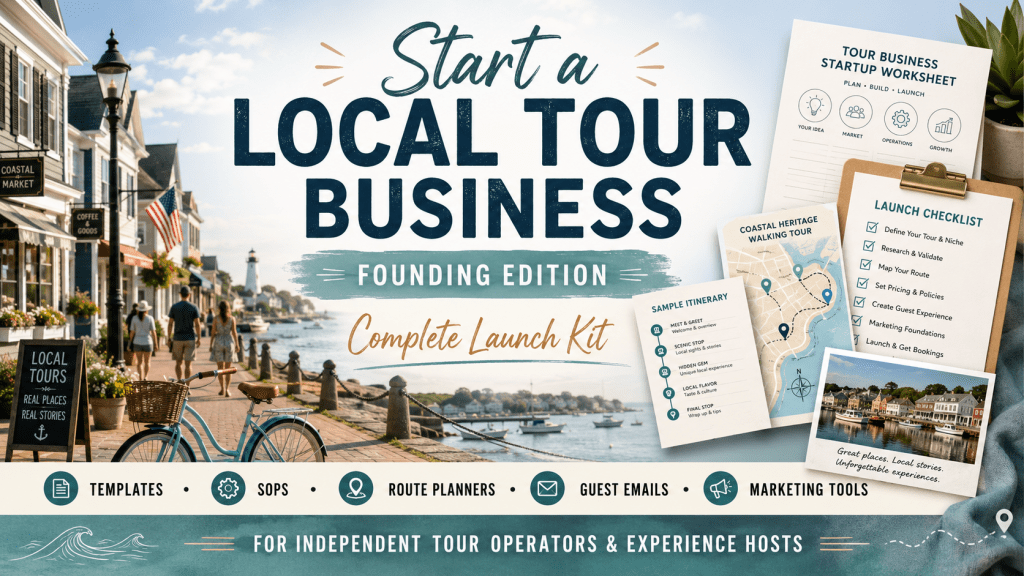
That is why I created Start a Local Tour Business: Founding Edition.
Introducing Start a Local Tour Business: Founding Edition
Start a Local Tour Business: Founding Edition is a complete launch toolkit for aspiring tour operators, local guides, experience hosts, travel creators, e-bike enthusiasts, and tourism entrepreneurs who want to build their own independent local tour business without starting from scratch.
It was inspired by the real-world buildout of Cycle-logical Tours, a coastal North Carolina e-bike tour company, and turned into a general educational toolkit that can be adapted to many types of local experiences.
This is not a franchise. It is not a brand license. It is not a protected territory or done-for-you business. It is a practical template library and launch system to help you build your own independent business with your own name, brand, insurance, legal setup, pricing, and local requirements.
What’s Inside the Local Tour Business Launch Kit?
The toolkit includes:
Business Foundation
- Local Tour Business Setup Workbook
- Business Model Planner
- Ideal Guest Profile Worksheet
- Market Research Checklist
- Offer Positioning Worksheet
Tour Concept and Route Creation
- Tour Concept Planner
- Route Creation Template
- Stop-by-Stop Route Builder
- Timing + Distance Calculator
- Accessibility + Safety Notes
- Route Testing Checklist
Tour Script and Storytelling
- Tour Script Template
- Story Bank Worksheet
- Opening Script Template
- Closing Script Template
- Guest Engagement Prompts
Operations and SOPs
- Guest Experience SOP
- Pre-Tour SOP
- Day-of-Tour SOP
- Post-Tour SOP
- Safety SOP
- Weather SOP
- Incident Response Checklist
- Monthly Operations Checklist
Booking and Payments
- Booking Platform Setup Checklist
- Payment Setup Checklist
- Guest Confirmation Email
- Reminder Email
- Waiver Checklist
- Refund + Cancellation Policy Template
Website and Brand Foundation
- Website Page Checklist
- Homepage Copy Template
- Tour Page Copy Template
- About Page Template
- FAQ Template
- SEO Starter Checklist
Marketing and Launch
- 30-Day Launch Calendar
- Social Media Caption Bank
- Short-Form Video Ideas
- Email Launch Sequence
- Local PR Template
- Chamber Outreach Template
- Local Partner Outreach Scripts
Financials and KPIs
- Startup Cost Estimator
- Pricing Calculator
- Monthly Revenue Projection Sheet
- Break-Even Calculator
- KPI Tracker
- Weekly Business Review Template
Optional Team and Guide Training
- Guide Training Checklist
- Guide Expectations Template
- Guest Service Standards
- Shadow Tour Checklist
Bonus Resources
- Vendor Checklist
- Insurance Questions Checklist
- Equipment Checklist
- Local Collaboration Ideas
- Future Updates
Who Is This For?
This toolkit is for you if you want to start or organize a local tour business around:
- Walking tours
- E-bike tours
- Bike tours
- History tours
- Ghost tours
- Food tours
- Coffee tours
- Film location tours
- Nature tours
- Wellness walks
- Photography tours
- Hidden gem tours
- Cultural experiences
- Airbnb-style experiences
- Small-town tourism
- Coastal tourism
- Local storytelling
It is especially helpful if you are thinking:
- “I have a tour idea, but I don’t know what documents I need.”
- “I want to launch, but I need structure.”
- “I don’t want to write every email, checklist, and SOP from scratch.”
- “I need help organizing the guest experience.”
- “I want my tour business to feel professional from the beginning.”
- “I know my town has potential, but I need a plan.”
Who This Is Not For
This toolkit is not for someone who wants a franchise, a guaranteed business opportunity, a protected territory, or permission to use the Cycle-logical Tours brand.
It is also not a replacement for legal, tax, insurance, safety, or compliance advice.
You are responsible for adapting the templates to your own market, business model, insurance requirements, local rules, and professional guidance.
Why Templates Help
Templates do not build the business for you.
But they do reduce the friction.
Instead of staring at a blank page, you can start with:
- a route planner
- a launch checklist
- a guest email template
- a pricing calculator
- an SOP structure
- a website copy outline
- a partner outreach script
- a financial tracker
Then you customize it for your market.
That is the difference between “I have an idea someday” and “I know what to work on next.”
Start Building Your Tour Business Today
If you want to start a local tour business, you do not need to build every system from scratch.
You need a clear starting point.
Start a Local Tour Business: Founding Edition gives you the templates, SOPs, route planners, guest emails, safety checklists, marketing tools, and financial trackers to begin organizing your own independent tour business.
Founding Edition is available now for $297.
FAQ: Starting a Local Tour Business
How do I start a local tour business?
Start by choosing a clear tour concept, researching your local market, planning a safe and practical route, setting up booking and payment tools, creating guest communication templates, preparing safety and weather policies, and launching with a simple marketing plan.
What type of tour business can I start?
You can start many types of local tour businesses, including walking tours, e-bike tours, food tours, ghost tours, history tours, nature tours, wellness walks, photography tours, film location tours, and local culture experiences.
Do I need templates to start a tour business?
You do not have to use templates, but they can save time and help you organize your business faster. Templates are especially useful for guest emails, SOPs, route planning, pricing, website copy, and launch marketing.
What should be included in a tour operator SOP?
A tour operator SOP may include pre-tour setup, guest check-in, safety briefing, equipment check, route process, weather decisions, incident response, post-tour follow-up, and monthly operations review.
Is this a franchise or license?
No. Start a Local Tour Business: Founding Edition is an educational toolkit. It is not a franchise, brand license, protected territory, done-for-you business, or guaranteed income program.
Can I use the Cycle-logical Tours name?
No. Purchase does not include any right to use the Cycle-logical Tours name, logo, brand identity, trademarks, website copy, marketing identity, or operating identity. You will build your own independent business with your own name and brand.
Is this only for e-bike tours?
No. While the toolkit was inspired by the real-world buildout of an e-bike tour company, it can be adapted for walking tours, food tours, history tours, ghost tours, nature tours, wellness experiences, photography tours, film location tours, and other local experiences.
How much does the toolkit cost?
The Founding Edition is currently available for $297. Future versions may increase as the toolkit is expanded and refined.
Ready to Start?
Build your own local tour business without starting from a blank page.
 Cycle-logical Tours
Leave a comment